Positioning you can prove — so autonomous machines and people can finally share the same mine. Safer than exclusion. Productive around the clock.
A kilometre down, nobody can prove where anyone is.
GPS reads zero underground. Position is a guess — and the guess is killing people. Fatalities among the world's largest miners are rising, not falling.
The industry's answer is exclusion. Exclusion is downtime.
- Autonomy zonesAutonomous machines run behind physical barriers and light curtains. One person crosses the line — the whole level shuts down.
- Blast re-entryAfter every blast the level stands empty for hours while gases clear — machines wait with the people.
- Shift changeThe mine empties, travels, and refills — twice a day, every day, with production idling in between.
“The underground automation area is fully isolated with safety barriers.”
Epiroc, on today's state of the art in underground autonomyA major copper mine's loading fleet ran at a quarter of its capacity.
Not because machines break — because the operating model keeps stopping them. Every hour of exclusion is capacity the mine already paid for and doesn't use. Safety is being bought with three quarters of the mine.
Safe or productive is a false choice.
It only exists because position underground is a statistical estimate — five to ten metres, ninety-five percent of the time. No regulator, and no sane mine manager, lets a 60-tonne machine move near people on “95% of the time”. Make position a proof, and the trade-off dissolves.
It can never arrive early.
Ultra-wideband ranging measures time-of-flight at the speed of light. Reflections and obstructions only ever make a distance read too long — never too short. The error has one sign.
Combine measurements from several anchors and the one-sided errors carve out a proven localization volume: a region mathematically guaranteed to contain the tag. Not an estimate. A proof.
Lighthouses on the walls. A proof around every machine.
- 01Anchors — the fyrarBlast-hardened UWB anchors every 30 m, two cables per tunnel. ~2 hours of installation per kilometre.
- 02Chips on everythingEvery person, vehicle and machine carries a tag with a live proven localization volume.
- 03Protective shieldsEach shield = proven volume + the distance that unit needs to fully stop. Shields move with the machines, recalculated continuously.
- 04Guaranteed stopShields overlap → the machines stop. Engineered to SIL-3 / PL-e — safety a certifier can sign.
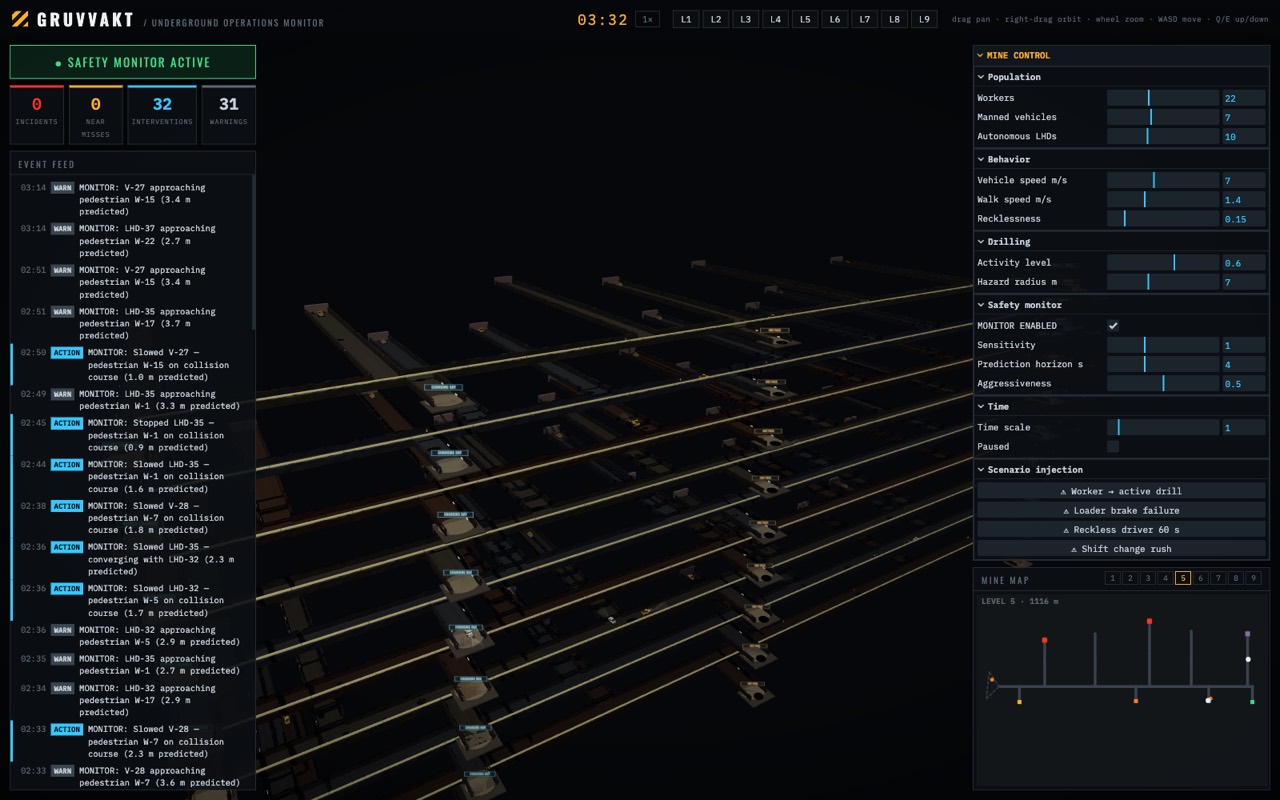
Every person. Every machine. Proven, live.
One operating picture for the whole mine: positions with guarantees, predicted conflicts, and every intervention logged as evidence. The shield does the stopping — the control room finally sees the mine it runs.
Mixed traffic turns excluded hours into producing hours.
Machines re-enter first after a blast. They keep hauling through shift change. A technician walks a live level and nothing shuts down — shields shrink speed instead. In our calibrated digital twin of an LKAB-style operation:
The gap hours alone are worth mining: at Westgold's Big Bell, autonomous loaders working only shift changes and re-entry windows delivered 10,000–12,000 t/month above forecast. FYR extends that from the gaps to the whole day.
The law is already ahead of the industry.
Regulators are writing cheques the industry can't cash. FYR is engineered to the standard the mandates imply — provable, certifiable, SIL-3 — before enforcement catches up worldwide.
Four forces, one moment.
We sell the layer everything else depends on.
The positioning layer compounds faster than the automation market it enables — and mandates convert “nice to have” into law: South Africa's collision-avoidance market alone is heading from $234M to $876M (2024→2034).
Everyone else monitors, interrupts, or excludes. We prove.
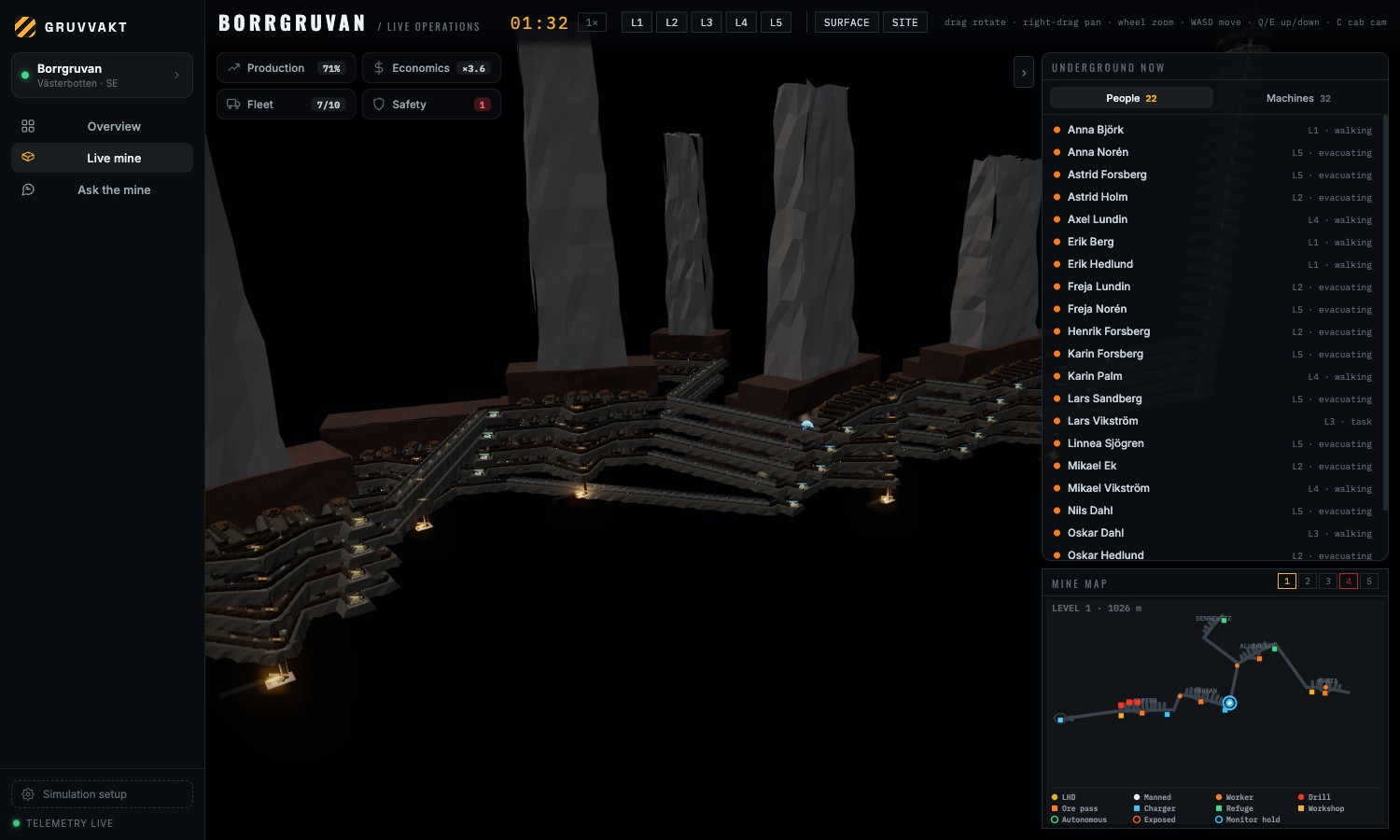
The mine never empties. The ore never stops. Nobody gets hit.
Machines re-enter first after every blast. Production runs through shift change, breaks and nights. People go underground when their judgment is needed — and walk live levels under a guarantee, not a guess. The industry's oldest trade-off, retired.
Built by people who've shipped underground.
One line: the operating or domain credibility that makes this person inevitable for this company.
One line: UWB / functional-safety / real-time systems track record.
One line: IEC 61508 / ISO 13849 assessment experience — the hire investors will ask about.
One line: years underground at a tier-one operator; speaks the customer's language.
One line: operator-side or OEM heavyweight lending distribution credibility.
One line: standards / regulatory figure (EMESRT, ISO 21815, Minerals Council).
Light the first mine.
Production pilot with a tier-one Nordic operator: one level, live mixed traffic, evidence pack for certification.
SIL-3 / PL-e assessment of the positioning chain — the first functionally-safe positioning layer in mining.
South Africa's Level-9 mandate first, then every jurisdiction that follows. Hardware + per-tag SaaS.
18 months of runway: pilot hardware, the certification programme, and the safety-engineering hires that make FYR the reference. amount + terms to fill